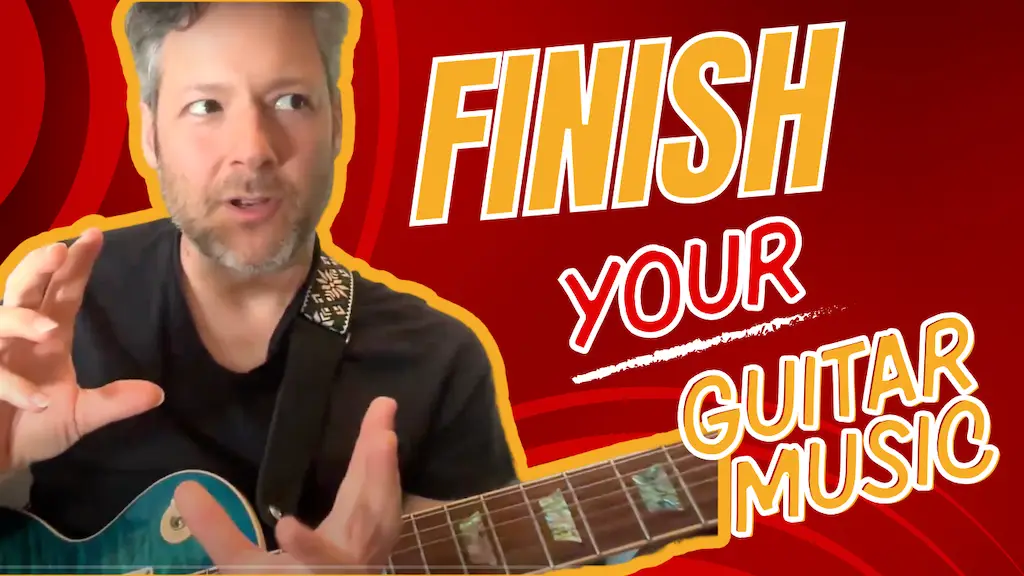

Guitarist rut: How to get out?

Do you feel like you’re playing the same thing over and over again on the guitar, a lack of motivation or stuck in a rut? Here are my top 10+ tips for you!
Before we begin, let’s talk about what a guitar rut is. A guitarist’s rut is similar to a writer’s block. Ideas don’t seem to flow out and what you play reminds you of something you either played before or heard it somewhere else.
It means you’ve hit a plateau in your playing, feel like you’re losing interest and excitement, and lack of progress.
But the good news is that you are aware of that. That’s a good sign! It means you’re ready to do something about it and make a change.
Because I’ve experienced it myself as a guitarist and composer, and I know of many other musicians who have been through this themselves, I’ve compiled a list of tips that work.
You don’t have to try all of them. Begin with one that stands out for you, try it and see if it makes any change. There’s no one solution, you’d need to find your unique way out.
1. Remind yourself the “why”
What made you pick up the guitar in the first place? Go back to that special time and place and relive it. Try to remember what made you want to have one and learn it?
This can rekindle your passion and connect you to your younger self and follow that old dream that’s probably burning inside. Then, define your ultimate goal and build the small steps you need to get there!
- The reason why I decided to learn the guitar is because I wanted to create my own music with it. I never lost touch with this goal and every time I feel in a rut I remind myself what my true passion and goal are, and it still drives me to this day.
What is your “why”?
2. Broaden your horizons
If you’re playing the same things, it means that you probably need to gain new perspectives on what music can be. Open up to other types of music in different genres, and listen to various styles and artists to gain new approaches to creating music.
- If you never listened to Flamenco, put on some Paco De Lucia or Vicente Amigo (my personal favourites). It can be the same with other styles. How about classical music? I remember listening to Vivaldi’s guitar concerto in D and found it very inspiring. Or maybe free improvisation by guitarist Derek Bailey that will show you unorthodox ways to play the guitar.
The list can go on and on… Can you pick something that is not in your usual playlist?
3. Dive into a piece of music
Once you find a guitarist or composition that excites you, dive into it. Transcribe it by ear, get the official TAB and sheet music, memorise it, analyse it from every possible angle, and try to identify what is unique about this music and then model it.
To really understand a piece of music on a deeper level, you need to get into the mind of the guitarist/composer and then to be able to teach it.
- I remember preparing one of my students for a diploma in guitar performance. I suggested a piece by guitarist Alan Gogoll’s pieces because I thought it was unique and doable (compared to his more challenging pieces). Only when I had to transcribe in order to teach it, I understood more about the nuances and complexities of that specific piece.
Have you ever taken a deep dive into this kind of learning experience?
4. Recharge your battery
As guitarists, I think it’s easy to forget what music is about because there’s a lot of focus on the actual instrument and the various techniques of playing it.
But it’s important to remember that music is more than playing chords and guitar solos. Music is an effective way to convey and express emotions. And these emotions come from our everyday life experiences.
So when feeling empty, watch an exciting film, read a novel, meet friends… whatever excites you! Then, when you’re recharged, play and hear the difference.
This might give your playing an added dimension, because even if you’re going to play the same things you already know, you’ll be able to use them to express what you feel.
- Personally, I love going for a walk in nature, or if possible, taking the guitar to nature and playing while resting on a tree. Taking a break from the guitar also works for me sometimes.
Which life experiences get you recharged?
5. Get inspired from non-guitar instruments
The way we guitarists think is different from other instrumentalists. Other musicians have keys, valves, beaters to play with, and the way they hold and play their instruments means that the whole approach is different.
So to get inspired by other instruments, you can:
- Learn them. For example, learning piano helped me better understand harmony – we can play more than six notes at a time… learning drums helped me better understand rhythm.
- Play music that was originally written for other instruments. You can use existing arrangements, or better, create your own arrangement. For example, I’ve found that Gymnopédie No.1 by Erik Satie is a beautiful piece to play on the guitar that can also challenge your fingers.
- Borrow their tools. For example, you can use a bow, Jimmy Page style (or Jónsi from Sigur Rós).
Which of these options excites you the most?
6. Experiment with new types of tunings
If you’re not experienced with alternate tunings yet, this is definitely a journey that you should explore. It usually gives instant gratifications, especially when the guitar is tuned to a chord, which means that it sounds good when playing open strings.
It can also feel like learning a completely new instrument! Then you either learn the various scales, keys and chords in the new tuning, or use your ears and free yourself from the need to know.
- There are music pieces I couldn’t have composed any other way without alternate tuning. For example, here’s an interesting one:
You can start with drop-D or DADGAD and experiment with less conventional tunings. Or better, can you create your own alternate tuning?
7. Play around with sound
Even if you play the same thing, you can hear it differently by implementing the other elements of music. For example, timbre (or sound/tone/colour) can make your music sound completely different.
To explore it, you can play with pickups on electric guitar, move the position of your picking hand on acoustic guitars, try other types of guitars, effects, and experiment with guitar accessories like slides, capos, plectrums, and even unrelated objects.
- Sometimes just adding a reverb does the trick. That’s one of the main characteristics of my own sound on electric guitar. For acoustic guitars, you can go into a space with natural echo like a bathroom, a corridor, or a cave. I’ve tried and enjoyed them all!
Can you find your own sound?
8. Jam with others
When we practise guitar, we usually do it alone, and it can become a problem when it stays that way. It’s because music is about connecting people, so when we play on our own, we can definitely feel disconnected.
The solution is therefore simple – play with other musicians. Even if you don’t know anyone who plays, it’s so easy these days to find online collaborations, like joining FB groups that were created for that purpose.
- There are also loads of opportunities to “remix” music that other players post on social media. For example, I really liked this drum track and it inspired me to create this music with it.
If you’ve already played with someone, did you also feel like you’re stuck in a rut or inspired?
9. Use your voice
One of the reasons why we can feel stuck is because we tend to think too much with our fingers. When we learn patterns, like scales and chord shapes, we follow sequences and without noticing get stuck in a mindset of playing formulas that sound good. They trap us in boxes.
So no wonder why we feel that we play mechanically while losing touch with the emotional side of music. How can we create something meaningful by just repeating motoric formulas?
One of the solutions is to think less with our fingers and get inspiration from other sources, like using our voice. Playing and singing in unison with the guitar is called scatting.
- You might worry about your singing abilities, so let me assure you that if this worked for me it can work for you. I’m definitely not a great singer and it still helped me find new ways to create music on the guitar. Here’s a short video I made about it that can get you started.
Do you see how this can also help with finding your voice on the guitar?
10. Adopt an open and creative mindset
By changing your perspective about the rut, you can see how it can become a great opportunity to learn something new and grow from it. This can work by allowing yourself to be open and connect to your natural curiosity.
There’s always something you haven’t tried yet. A different technique, a style, a composition tool, a new scale, music theory concepts… it’s endless. And once you immerse yourself in it, it will inspire you.
- After 31 years of playing the guitar and learning music from every possible angle, I always do my best to “stay hungry, stay foolish” and use creative challenges as an opening to new possibilities.
How would you describe your current mindset?
11. Commit to a learning process
With all the endless youtube videos, online courses, guitar apps and vast amounts of resources, it can feel overwhelming. And we have too many choices to choose from, we usually get stuck.
But there’s no substitute for learning directly from humans (at least yet…). Experienced and accomplished guitar teachers and guitar coaches can help with identifying what’s holding you back and prescribing the best individual roadmap for you to overcome your rut.
They can also give you the right tools for you (for example, with all of the above), so that when you feel stuck again, you’d know how to break out.
- I couldn’t get to where I am today without the help of all my teachers. From my first serious guitar teacher who’s now a renowned composer to my latest Flamenco guitar teacher who took me to play with his dance group after each lesson.
Learning is a never-ending process. Getting into a rut simply means that you’re ready to move on to your next adventure. Do you agree?
This is it, so far, my guitar friend!
I really do hope you enjoyed this post found it valuable! You can get more resources by following new posts in my solo guitar composition artistry group and feel free to invite others who might benefit from lessons, tutorials and inspirations as well!
If you need personal help, I’d like to invite you to have a guitar chat with me, where we can talk about your challenges and goals, and to see how I can help you.
You can book this free 1:1 session directly through my calendar using the following link: https://udiguitar.com/contact/.
Invest in yourself and create great music!
- Would you like to add anything to the list? Comment below.